How ARTFCL turned shoppers' ideas into print-ready products
ARTFCL wanted shoppers to design their own artwork right on a product page, then buy it as a canvas or framed print. OneNine built the whole platform: an embeddable AI art widget, a Shopify app, and a backend that sends every order to the print partner automatically.

At a glance
1 snippet
to embed the widget on any website
11
art styles, from oil paint to pop art
28
API endpoints on a serverless AWS backend
0
manual file transfers between an order and the printer
The problem
Selling personalized art online usually means a designer in the loop, back-and-forth emails, and files passed to a printer by hand. ARTFCL wanted it to feel instant for the shopper and invisible for the team.
Creation at the point of sale
Shoppers had to go from an idea to a finished image without leaving the product page, on any store, not just one theme.
Fulfillment without people
Every order needed the right high-resolution file, format and SKU sent to the printer, without anyone downloading and uploading files.
AI models change fast
Image generation providers evolve every few months. The product could not be rebuilt each time a better model appeared.
How we got there
We treated it as a platform rather than a one-off store customization.
Fall 2024
A widget, not a theme hack
We designed a multi-tenant platform: companies own widgets, and each widget is whitelisted for specific domains. ARTFCL's own Shopify store became the first tenant, and any other retailer could be next.
Late 2024
Great results for non-experts
We added formats, style presets and an "Improve my prompt" assistant so shoppers who have never written a prompt still get striking results.
Early 2025
Switching AI providers without breaking anything
The first version generated images with MidJourney through a third-party API. We moved generation to Flux on Replicate and added OpenAI for prompt work, behind a provider layer, so the widget did not change.
2025
Orders straight to the printer
A Shopify order webhook saves the order and pushes each print-ready file to the print partner's storage, named by order item and SKU.
The solution
Three pieces work together: the widget shoppers use, the Shopify app merchants install, and the API that connects creation to fulfillment.
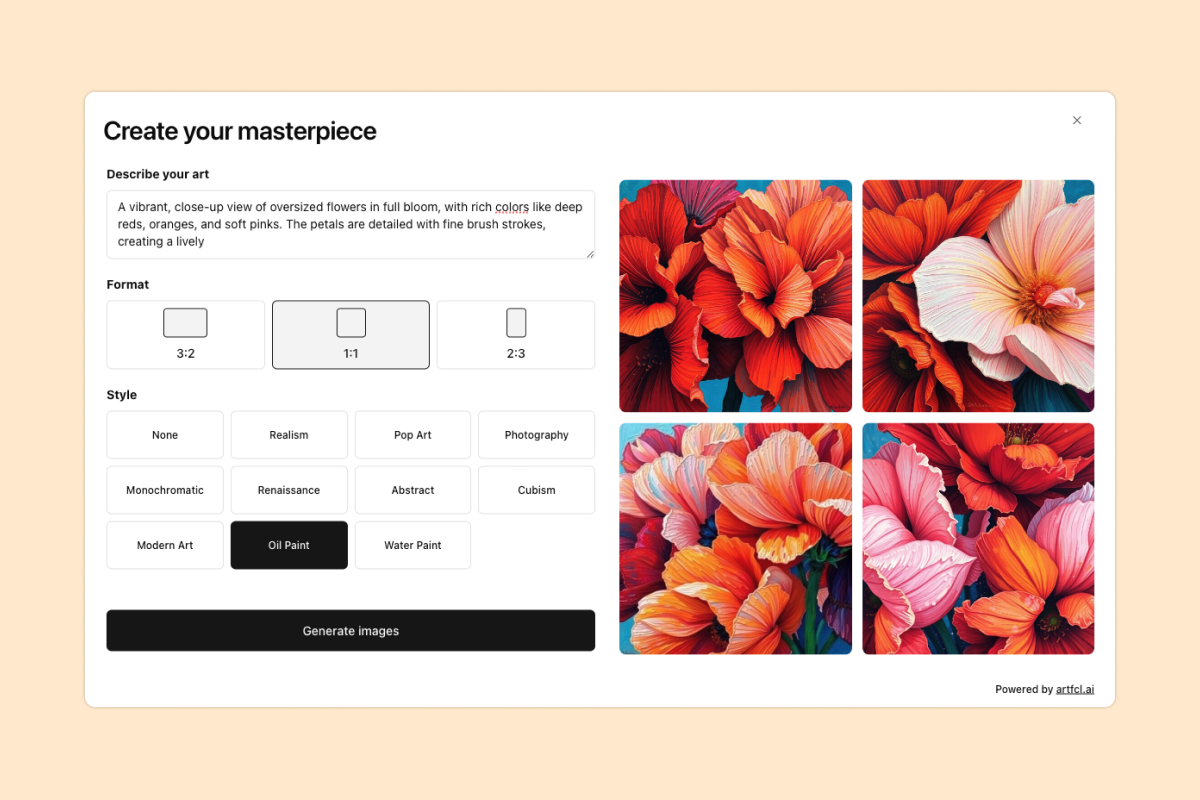
Create your masterpiece
Shoppers describe what they want, pick a format and one of 11 styles, and get four original images in seconds. They can also start from a reference image.
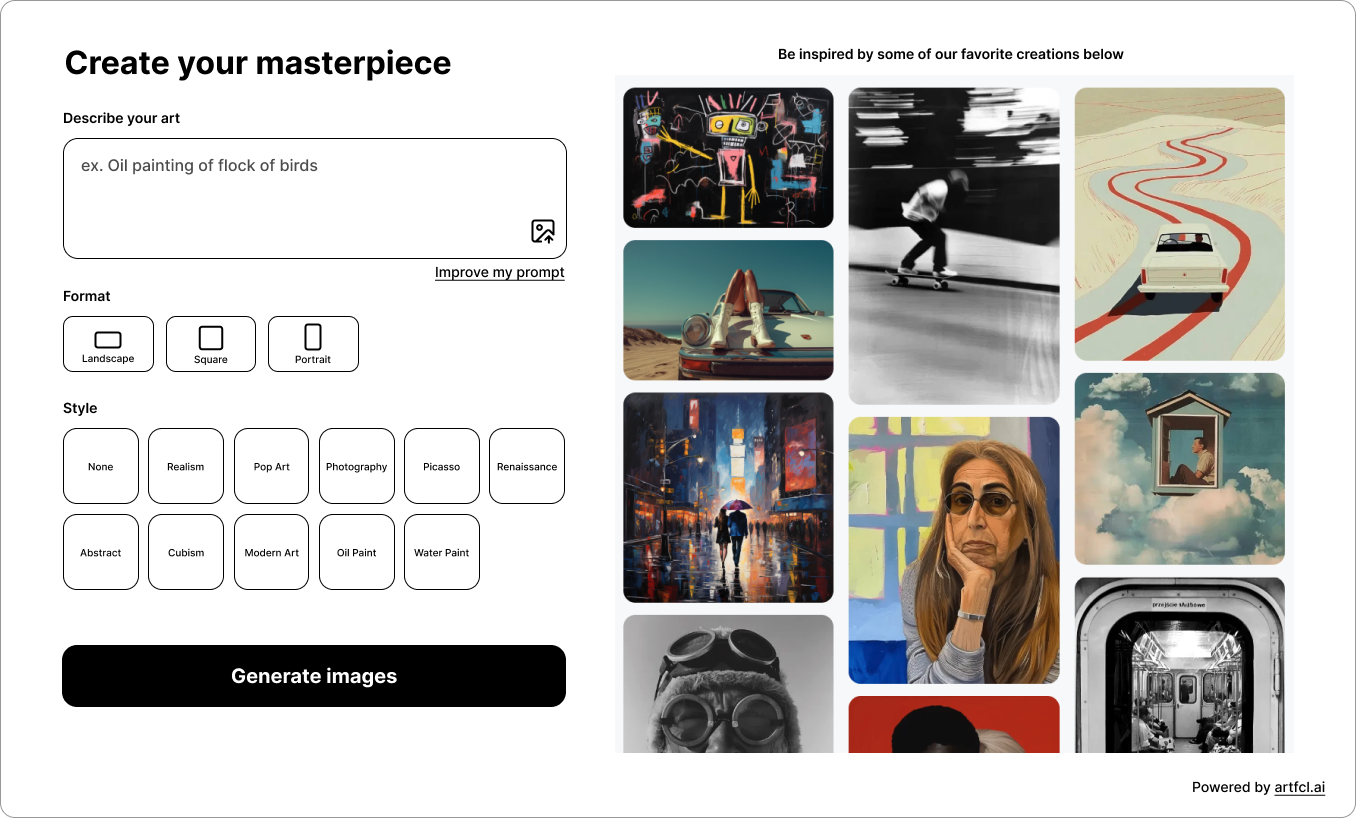
Help for every shopper
"Improve my prompt" turns a rough idea into a detailed description, and a gallery of favorite creations gives shoppers a place to start.
From image to framed print
Shoppers pick their favorite and buy it as a canvas or framed print. The order flows through Shopify like any other product.
One snippet to embed
Retailers add the widget with a code snippet or as a Shopify theme block, then whitelist their domains. Secure APIs give them access to orders and transactions.
Under the hood
A serverless platform on AWS, designed to absorb traffic spikes and survive changes in the AI market.
How it works, step by step
- 1
Widget loads
The embed checks the website against the widget's whitelisted domains.
- 2
Prompt refined
OpenAI refines the shopper's idea and applies the selected style, with a safe-for-work filter on every prompt.
- 3
Images generated
Flux models on Replicate generate four options, stored in Amazon S3.
- 4
Usage protected
Redis-based rate limits protect the AI budget from abuse.
- 5
Order placed
Shopify's order webhook records the order, the shipping address and each line item.
- 6
Sent to print
The print-ready image is copied to the print partner's storage, named by order item and SKU.
Technology
Engineering safeguards
- Multi-tenant authorization with per-widget domain whitelisting
- A provider layer that let us replace MidJourney with Flux without touching the widget
- Safe-for-work filtering and rate limiting on every generation
- Shopify GDPR webhooks for customer data requests and deletion
- Database migrations applied automatically on every deploy, and documented OpenAPI
Benefits
Time saved
Personalized products without a design or fulfillment team in the loop.
- No designer needed: shoppers create the artwork themselves
- No manual file handling: print files reach the printer automatically
- One widget to maintain for every store, instead of a custom build per retailer
Revenue impact
Personalization turns browsing into a one-of-a-kind purchase.
- Every generated image is a product that can be bought as a canvas or framed print
- Retailers add a personalized product line with a single snippet
- A multi-tenant platform ARTFCL can offer to other retailers, not just its own store
Why OneNine
Why ARTFCL built with OneNine
Generative AI shipped as a product
We turned an image model into something shoppers use and buy from, not a tech demo.
Built to outlast model churn
When a better model came along, we switched providers without rebuilding the product.
Commerce from end to end
Widget, Shopify app, payments, webhooks and fulfillment, designed as one flow.
Serverless by default
Infrastructure as code on AWS that scales with traffic and costs little when idle.